ISS SuperCode
Introduction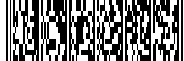 SuperCode
was invented by Ynjiun Wang in 1994 and is in the public domain.
The symbology uses a packet structure, a variant of a multi-row
symbology. There are precise rules for the horizontal placement
of symbol characters in a packet, but greater freedom in placing
packets vertically and horizontally than offered by a matrix
of columns and rows in a multi-row symbology. SuperCode
was invented by Ynjiun Wang in 1994 and is in the public domain.
The symbology uses a packet structure, a variant of a multi-row
symbology. There are precise rules for the horizontal placement
of symbol characters in a packet, but greater freedom in placing
packets vertically and horizontally than offered by a matrix
of columns and rows in a multi-row symbology. The packet structure of SuperCode ensures that each symbol character encoding a data or error correction codeword is adjacent to a symbol character encoding the packet address. Thus the sequence of codewords is known regardless of how the packets are arranged. Not only does this allow for non-rectangular symbol shapes, but the packets do not have to abut one another physically. Features¤ Packet Structure: (Inherent) The packet structure of SuperCode ensures that each symbol character encoding a data or error correction codeword is adjacent to a symbol character encoding the packet address. Thus the sequence of codewords is known no matter how spatially arranged are the packets. Not only does this allow for non-rectangular symbol shapes, but the packets do not have to abut one another physically.¤ Error Correction: (Inherent) SuperCode symbols have error correction codewords, based on Reed-Solomon error correction algorithms, which can be used not only to detect errors but to correct erroneously decoded or missing codewords (see ). A user may select one of 32 error correction levels. ¤ Extended Channel Interpretations (ECI): (Optional) This mechanism enables characters from other character sets (eg Arabic, Cyrillic, Greek, Hebrew) and other data interpretations or industry-specific requirements to be represented. ¤ Logical Layer Designator (LLD): (Inherent) This mechanism allows various structures of the symbol. Five Logical Layer Designators are specified (see ). One LLD is allocated to the ECI scheme, common to a number of symbologies. For more information visit www.aimglobal.org. |