Introduction
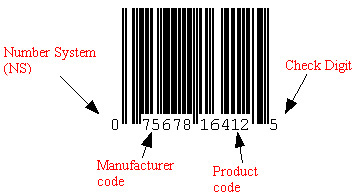
The UPC-A barcode is the most common and well-known symbology
in the United States.
You can find it on virtually every consumer goods in your
local supermarket, as well as books, magazines, and newspapers.
There are a number of UPC variants, such as
UPC-E,
UPC 2-digit Supplement,
UPC
5-digit supplement.
UPC-A encodes 11 digits of numeric data along with a trailing
check digit, for a total of 12 digits of barcode data.
The human-readable digits are printed for the benefit of
us lowly humans only. Obviously, the scanner doesn't pay
any attention to them whatsoever and a barcode that is printed
without these numbers will work just as well as one that
includes them.
Structure of a UPC number
A UPC-A number consists of four areas:
1. The Number System;
2. The Manufacturer Code;
3. The Product Code;
4. The Check Digit.
Normally the number system digit is printed to the left of
the barcode, and the check digit to the right. The manufacturer
and product codes are printed just below the barcode, separated
by the guard bar.
Number System
The number system is the first digit in the UPC number to
identify the type of the product. For example, if the barcode
starts with digit 5, this barcode is a coupon code.
| NS |
Description |
| 0 |
Regular UPC codes |
| 1 |
Reserved |
| 2 |
Weight items |
| 3 |
Durg/Health items |
| 4 |
In-store use on non-food items |
| 5 |
Coupons |
| 6 |
Reserved |
| 7 |
Regular UPC codes |
| 8 |
Reserved |
| 9 |
Reserved |
Manufacturer Code
The manufacturer code is assigned by UCC council to each manufacturer
or company which distributed goods that uses UPC-A barcode.
To apply for a manufacturer code, visit www.uc-council.org.
Note that UCC has started to assign manufacturer code longer
than 5 digits to conserve the numbering resource.
Product Code
The product code is assigned by the manufacturer. The product
code is a 5-digit number so it can accommodate 99,999 possible
product codes for each manufacturer. That is far enough
for any manufacturer in the world!
Check Digit
The check digit is used to verify that the barcode is generated
or scanned correctly. The check digit is calculated based
on the rest of the barcode digits. Read the following section
to learn how to calculate the check digit.
The nominal X dimension is 13 mils. The printable X dimension
ranges from 10.4 to 24 mils.
                <h3>Coupon Code </h3>
			    The coupon code is a UPC code with number system 5. <br>
                A coupon code contains four areas: <br>
                1. Number System 5<br>
                2. Manufacturer Code<br>
                3. Product Family code and value code<br>
                4. Check Digit<br>
                <br>
                <h3>Check Digit Calculation </h3>
UPC-A check digit is calculated using standard Mod10 method. <br>
                Here outlines the steps to calculate UPC-A check digit:<br>
                1. From the right to left, start with odd position, assign
                the odd/even position to each digit.<br>
                2. Sum all digits in odd position and multiply the result
                by 3.<br>
                3. Sum all digits in even position.<br>
                4. Sum the results of step 3 and step 4.<br>
                5. Divide the result of step 4 by 10. <br>
                <br>
                The check digit is the number which adds the remainder to
                10.<br>
                <br>
                <h3>Encoding</h3>
A UPC-A symbol can be divided into two halves, each consisting of six digits
                separated by a center guard bar pattern. The whole symbol
                is surrounded by two guard bar patterns. The same digit has
                different encoding depends whether it is in the left halve
                or in the right halve. <br>
                <br>
                The encoding pattern for digits in the left halve always starts
                with a space while the one for digits in the right halve always
                start with a bar and ends with a space.
                <p>A UPC-A symbol has the following structure:<br>
                  1. Start guard bars, always with a pattern bar+space+bar<br>
                  2. Left halve, six digits encoded using the encoding schema
                  A or B<br>
                  3. Center guard bars, with a pattern space+bar+space+bar+space<br>
                  4. Right halve, six digits encoded using the encoding schema
                  C<br>
                  5. Stop guard bars, always with a pattern bar+space+bar<br>
                </p>
              </div>
                </td>
          </tr>
        </table> </td>
    </tr>
  </table></td>