Code 93
Introduction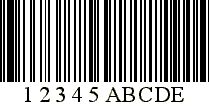 Code
93 was designed to provide a higher density and data security
enhancement to Code39. It is an
alphanumeric, variable length symbology. code93 is used primarily
by Canadian postal office to encode supplementary delivery
information. Every symbol includes two check characters. Code
93 was designed to provide a higher density and data security
enhancement to Code39. It is an
alphanumeric, variable length symbology. code93 is used primarily
by Canadian postal office to encode supplementary delivery
information. Every symbol includes two check characters.Code93 is designed to encode 26 upper case letters, 10 digits and 7 special characters: A, B, C, D, E, F, G, H, I, J, K, L, M, N, O, P, Q, R, S, T, U, V, W, X, Y, Z 0, 1, 2, 3, 4, 5, 6, 7, 8, 9 -, ., $, /, +, %, SPACE. Each Code93 character is divided into nine modules and
always has three bars and three spaces. In this way comes
the symbology name. Structure of a Code 93 barcodeA typical Code 93 barcode has the following structure:1. A start character –  2. Message encoded 3. First check character "C" 4. Second check character "K" 5. Stop Character - 6. Termination bar Check Digit CalculationTo calculate the check character "C" and "K", follow the following steps.1. Take the value (0 through 47) of each character in the barcode (see the table to the left). The start and stop characters are not included in the checksum calculation. 2. Assign the weight for each character. The right-most character has a weight value of 1, the second to last 2 and so on. After 20, the sequence goes back to 1. 3. Multiply the character value with weight. Sum all the results. 4. Divide the result by 47 and get the remainder. Reverse look up the remainder to get the character. This is check character "C". 5. Append the "C" character at the end of the data, and repeat the step1 through step 4. This time the weight ranges from 1 to 15. The result is the character "K". Extended Code 39 Encoding TableIt is possible, using Code 93's "Full ASCII Mode" to encode all 128 ASCII characters. This is accomplished by using the ($), (/), (%), and (+) symbols as "shift" characters. Those characters combined with the single character that follows indicate which Full ASCII character is to be used.The Extended Code 93 Encoding Table is identical to the Extended Code 39 Encoding Table except that Code 93 uses its four specialized shift characters ($), (/), (%), and (+) to shift to Full ASCII mode instead of Code 39 which isues the $, /, %, and + characters. Use the Extended Code 39 Encoding Table for Extended Code 93 encoding, and just remember to use the special characters ($), (/), (%), and (+) whenever the Code 39 Encoding table refers to $, /, %, and +. |